
Why Smart Entrepreneurs Buy Web Based Business Assets Instead of Building From Scratch If you want...
Why a Shopify Brokerage 90 Day Plan Is the Key to a Profitable Exit
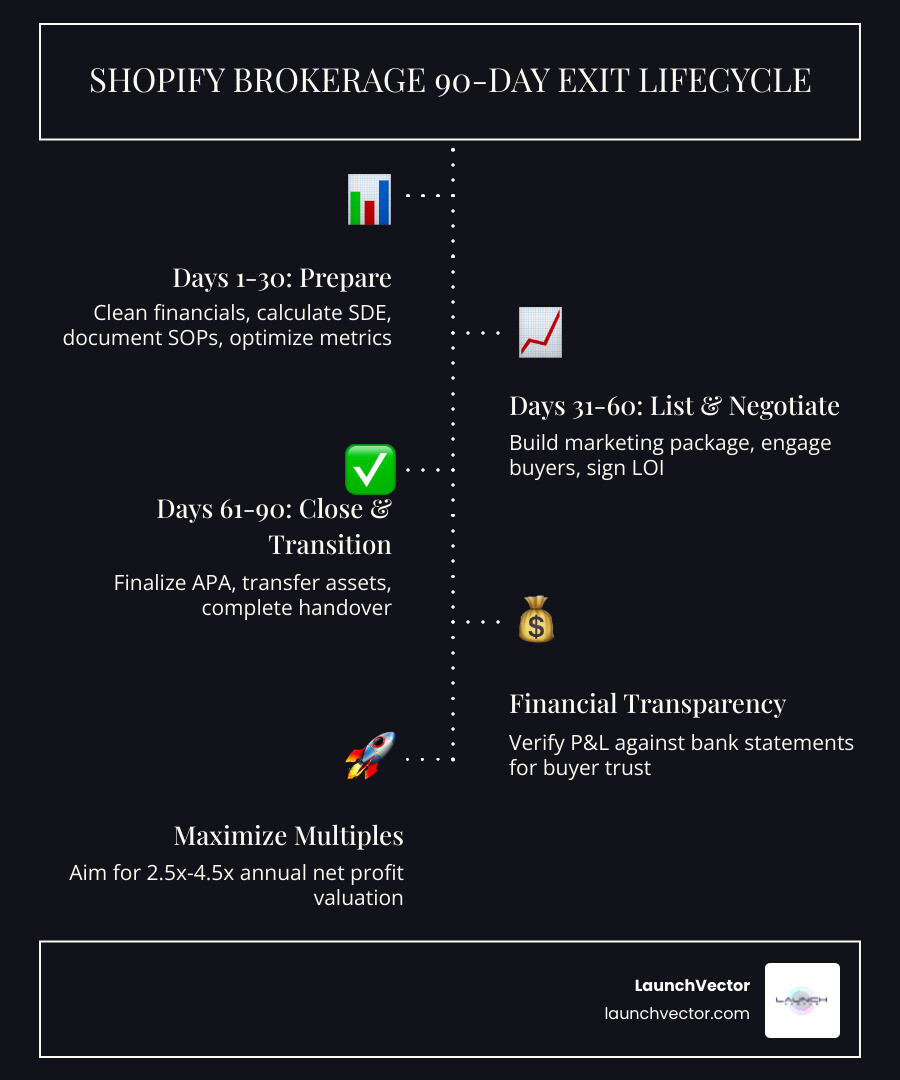
A shopify brokerage 90 day plan is a structured three-phase roadmap that guides Shopify store owners through preparing, listing, and closing a sale — all within 90 days — to maximize the value of their exit.
Here's what the 90-day plan covers at a glance:
- Days 1-30 — Prepare: Clean up financials, calculate your SDE, document SOPs, and optimize store metrics before listing.
- Days 31-60 — List and negotiate: Create your marketing package, engage qualified buyers, negotiate deal structure, and sign an LOI.
- Days 61-90 — Close and transition: Finalize the Asset Purchase Agreement, transfer assets, and complete seller training and handover.
Most Shopify store transactions take 4-6 months from kickoff to closing. But with the right brokerage process and preparation, the core work — from first steps to signed deal — can be compressed into a focused 90-day window.
The stakes are real. Quality Shopify stores typically sell for 2.5x to 4.5x annual net profit. That means a store earning $200,000 per year could sell for anywhere from $500,000 to $900,000. Getting the preparation and process right is the difference between leaving money on the table and walking away with a life-changing number.
Yet most sellers go in underprepared. Messy financials, over-reliance on the owner, single-channel traffic — these are the factors that kill deals or drag down multiples. A clear 90-day plan eliminates those risks before they become problems.
I'm Zac Richman, founder of Launch Vector, an eCommerce acquisition and operations firm where I've sourced, acquired, and scaled a multi-million dollar portfolio of Shopify stores — giving me a front-row seat to what makes or breaks a Shopify brokerage 90 day plan. In the sections below, I'll walk you through exactly what to do in each phase so you can exit with confidence and maximum value.
Phase 1: Preparing Your Store for the Shopify Brokerage 90 Day Plan (Days 1-30)
The first month of your shopify brokerage 90 day plan is all about getting your house in order. Think of this like staging a home before an open house. If a buyer walks in and sees piles of unorganized laundry (or in this case, messy spreadsheets), they’re going to wonder what else is broken under the hood.
Financial transparency is the cornerstone of a successful exit. In the first 30 days, we focus on Ensuring Financial Transparency: Verifying Profit and Loss Statements When Acquiring a Pre-Existing Shopify Brand. Buyers aren't just looking at your Shopify dashboard; they are looking for a paper trail that matches your bank statements.
One of the most critical steps in Understanding the First 30 Days with Launch Vector is the calculation of your Seller’s Discretionary Earnings (SDE). This isn't just your "net profit." It includes your salary, any personal expenses run through the business, and one-time costs that won't recur for the next owner.

Beyond the numbers, you need to document your Standard Operating Procedures (SOPs). If you are the only one who knows how to talk to your supplier or run your email marketing, your store is a "job," not an "asset." Buyers pay a premium for businesses that can run without the founder. We also look for traffic diversity—if 90% of your sales come from one TikTok influencer, your risk profile is too high. Aim for a mix of SEO, paid ads, and email revenue.
| Feature | Cash Accounting | Accrual Accounting |
|---|---|---|
| Timing | Records when cash hits the bank | Records when the sale occurs |
| Valuation Impact | Can look "lumpy" and inconsistent | Preferred by high-end brokers and buyers |
| Inventory | Expensed immediately | Recorded as an asset until sold |
| Accuracy | Good for small hobby stores | Essential for stores over $500k valuation |
Defining Your Exit Criteria and Valuation
Before you even talk to a broker, you need to know your "walk-away" number. Most Shopify stores are valued using a multiple of SDE. While the average is 2.5x to 4.5x, stores with 20%+ year-over-year growth can sometimes command 5x or 6x.
To get an accurate number, you must spend time Reading & Understanding Your P&L. We look at the "Four Pillars of Value": Documentation, Transferability, Risk, and Growth. If you’ve used a Shopify Free Trial: Your 90-Day Plan To Launch A Profitable Store to build a foundation, you already know that growth potential is what excites buyers the most. They aren't just buying what you did; they are buying what they can do next.
Maximizing Store Value Before Listing
You have 30 days to "buff out the scratches." Start with inventory management—don't let your best sellers go out of stock right before you list. Clean up your app stack; if you're paying $200 a month for an app you don't use, delete it. That $200 monthly saving adds $2,400 to your annual profit, which at a 3x multiple, adds $7,200 to your sale price.
Focus on margin improvement. Can you negotiate a 5% discount with your supplier? Can you implement a Shopify Marketing Strategy: 30-Day Playbook to $10K — UM to boost your Average Order Value (AOV)? Every dollar of efficiency you find in Month 1 is multiplied by 3 or 4 when you sell in Month 3.
Phase 2: Listing and Negotiation Strategies (Days 31-60)
By Day 31, your store should be a well-oiled machine. Now, it’s time to go to market. This phase of the shopify brokerage 90 day plan involves creating a "CIM" (Confidential Information Memorandum). This is a professional marketing package that highlights your brand's story, metrics, and growth opportunities.
We often recommend "blind listings" initially. This means the public can see your niche and your numbers, but not your URL. This protects your brand from copycats and ensures only serious, vetted buyers get the full details. When you find a match, you'll move toward a Letter of Intent (LOI).

Navigating the Shopify Brokerage 90 Day Plan Negotiation
Negotiation is about more than just the final price; it's about the deal structure. You might get an offer for $1 million, but if it’s $200k cash and $800k in an "earnout" (money paid only if the store hits future targets), it might not be the best deal.
In our experience Navigating the Intangible: A Guide to Investing in Pre-Existing Ecommerce Brands, we see many sellers overlook the benefit of seller financing. Offering to carry 10-20% of the purchase price as a loan can actually help you find a buyer faster and potentially get a higher overall price.
Once the LOI is signed, you enter the "exclusivity period." This is usually a 30-day window where the buyer does deep-dive due diligence. They will check your Shopify admin, verify your bank statements, and perhaps even talk to your suppliers. If you’ve followed our Phase 1 advice, this part should be a breeze.
Identifying High-Quality Buyers
Not all buyers are created equal. Some are "financial buyers" looking for a passive return, while others are "strategic buyers" who already own similar stores and want to merge yours into their portfolio.
When asking yourself Should You Buy an E-Commerce Brand, or when evaluating someone who wants to buy yours, look at their experience level. Do they have the funds? Do they have a plan? We also see a rise in Fractional Ownership: Reducing Risk, Empowering Investors, where groups of investors pool money to buy a high-quality asset. These buyers are often very sophisticated and move quickly.
Phase 3: Closing and the 90-Day Transition Period (Days 61-90)
The final stretch! This is where the legal and technical heavy lifting happens. You’ll sign the Asset Purchase Agreement (APA), the funds will move into escrow, and the migration begins.
As you Kickoff Your Financial Responsibilities as Partner, you’ll need to transfer everything: the Shopify domain, the email list, social media accounts, and supplier contracts. A standard transition period is 30 to 90 days. During this time, you are usually expected to provide a set number of hours of training and support to the new owner to ensure they don't crash the plane you just sold them.
Maximizing Value During the Shopify Brokerage 90 Day Plan Transition
A smooth handover is your final gift to the buyer—and it protects your earnout if you have one. You want to provide a Marketing Strategy for New Stores that helps the new owner hit the ground running.
This includes:
- Customer Support: Introduce the buyer to your support team or help them set up a new helpdesk.
- Staff Onboarding: If you have VAs, ensure they are comfortable with the new leadership.
- Operational Handover: Walk them through your weekly "to-do" list.
- Technical Migration: Ensure all API keys and app subscriptions are transferred correctly.
If the buyer sees that you are Unlocking Passive Cash Flow with E-Commerce for them, they are much more likely to be a happy partner during any post-sale payout periods.
Post-Acquisition Optimization and Scaling
For the buyer, the real work starts on Day 91. This is where we implement a How to Double Your Shopify Revenue in 90 Days: A Week-by-Week Plan | AdsX. We focus on "scaling signals"—doubling down on the specific ads or products that show the highest ROAS.
We also look at 90-Day Creator Growth | Scale Music, Writing & Art strategies to see if influencer partnerships can be expanded. The goal is to optimize the ad account, fix any conversion leaks on the product pages, and set up advanced email automation to increase customer lifetime value.
Avoiding Common Risks and Red Flags in Shopify Brokerage
Even with a perfect shopify brokerage 90 day plan, things can go sideways if you aren't careful. Here are the red flags we watch for:
- Traffic Fraud: If a store has a sudden spike in "direct" traffic right before listing, it could be bot traffic. Always verify Google Analytics.
- Supplier Stability: Does the seller have a backup supplier? If the main factory closes, the business dies.
- Owner Dependency: If the brand is built entirely around the owner’s face and personality, it’s much harder to sell.
- Declining Trends: A store doing $1M a year is great, but if it did $2M the year before, it’s a falling knife.
At Launch Vector, we believe in transparency, which is Why Launch Vector Offers 50% Equity: Unlocking Opportunities for Potential Clients. We want our interests aligned with yours.
Frequently Asked Questions about Shopify Brokerage
How is a Shopify store's SDE multiple determined in 2026?
In 2026, the multiple is determined by a combination of historical profit, traffic quality, and brand strength. Stores with high organic search traffic and a large, engaged email list (50,000+ subscribers) command the highest multiples, typically between 3.5x and 4.5x. Risk factors like "platform dependency" (e.g., relying only on Facebook ads) will push the multiple lower.
What are the standard broker fees and success structures?
Most professional brokers charge a "success fee" based on the final sale price. For deals under $1M, this is usually 10-15%. For larger deals, it may scale down to 5-8%. Some high-end M&A firms also charge a monthly retainer (ranging from $5,000 to $20,000) to cover the costs of marketing and vetting buyers.
How long does the typical Shopify store transition take?
While the sale itself can happen in 90 days, the "support period" usually lasts an additional 30 to 90 days. This ensures the buyer is fully trained on the systems and the supplier relationships are successfully handed over. A solid transition plan of 90 days or longer is often seen as a "bonus" by buyers and can help secure a better price.
Conclusion
Exiting your eCommerce business doesn't have to be a multi-year ordeal. By following a disciplined shopify brokerage 90 day plan, you can move from "thinking about selling" to "money in the bank" with surprising speed.
At Launch Vector, we specialize in this exact process. We don't just list businesses; we provide the M&A expertise, expert evaluations, and post-acquisition support needed for a truly seamless transition. Whether you are looking to buy your first revenue-generating asset or exit the brand you've spent years building, we are here to ensure the deal is hassle-free and optimized for maximum profit.
Ready to see what your store is worth or find your next acquisition? Get more info about the acquisition process and let's start your 90-day clock today.