What Is a Small Business Merger — and Is It Right for You? A small business merger is one of the...
The $10 Trillion Wake-Up Call: What Every Business Owner Needs to Know About Ownership Transition

Small business ownership transition refers to the process of transferring ownership and control of a business to a new owner — whether that's a family member, employee, third-party buyer, or through liquidation.
Here are the main paths available to you:
| Transition Path | Best For | Key Consideration |
|---|---|---|
| Family succession | Legacy-focused owners with capable heirs | Requires early planning and clear governance |
| Employee ownership (ESOP) | Businesses with strong internal teams | Tax advantages, but complex to set up |
| Third-party sale | Owners seeking maximum financial return | Longest process, highest valuation potential |
| Management buyout | Businesses with strong leadership in place | Employees buy in using seller financing |
| Liquidation | No viable successor or buyer | Fastest exit, lowest value recovery |
The honest truth? Most owners wait too long to think about this.
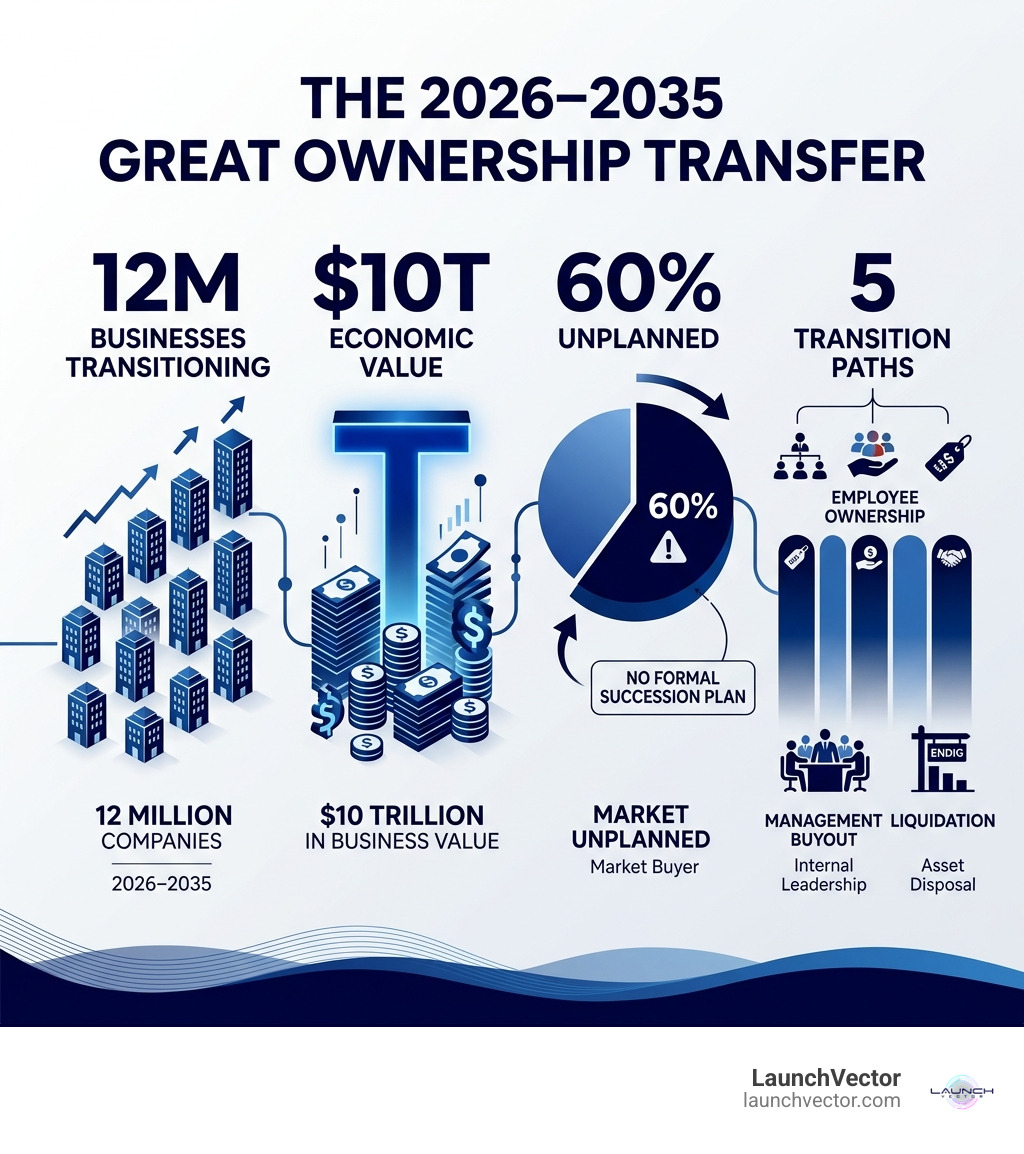
Right now, in April 2026, the United States is in the early stages of what researchers are calling the "Great Ownership Transfer." Baby boomers own an estimated 51% of all privately held businesses — more than three million companies worth nearly $10 trillion. Over the next decade, roughly 12 million businesses are expected to change hands.
The problem is that 60% of business owners have no formal succession plan. And the consequences are severe — up to 30% of small business closures are directly tied to a failed ownership transition.
This isn't just a personal financial risk. Small businesses employ more than 60 million Americans — nearly half the entire U.S. workforce. When a transition fails, the ripple effects hit employees, families, and entire communities.
I'm Zac Richman, founder of Launch Vector, an eCommerce acquisition and operations firm where I've navigated the complexities of small business ownership transition — sourcing, acquiring, and scaling digital businesses across multiple verticals. In this guide, I'll walk you through every major decision you'll face, from choosing the right path to executing a clean handover.
Understanding the Small Business Ownership Transition Landscape
The current era of business stewardship is more than just a series of retirements; it is a structural test for our economy. As we look at the data for April 2026, the sheer volume of businesses reaching the finish line is staggering. According to research on navigating the great small business ownership transition, roughly six million small and medium-sized businesses (SMBs) will face ownership transitions by 2035. Of those, over one million are viable candidates for sale, representing up to $5 trillion in enterprise value.
Despite these high stakes, the "readiness gap" remains our biggest hurdle. Currently, only about 33% of U.S. small businesses have a formal transition plan. When a plan is missing, the default outcome is often closure. In fact, 92% of SMB exits in recent years occurred via closure rather than transfer. This isn't usually because the businesses were failing; it's because the market infrastructure to pass the torch wasn't in place.
The Impact on Our Communities
The risk isn't distributed evenly. In rural states like Wyoming, small businesses are the lifeblood of the economy, often accounting for over 50% of total employment. When a long-standing local firm closes because the owner couldn't find a successor, it doesn't just end a career—it erodes the local tax base and removes essential services from the community.
Furthermore, there is a massive opportunity for economic mobility. Currently, only 28% of transferring business value is expected to accrue to women and Black and Latino individuals combined. Closing this participation gap through inclusive small business ownership transition strategies could unlock an estimated $3 trillion in new household wealth.
The Critical Timeline for a Small Business Ownership Transition
If you're thinking about exiting, your "today" should have started three years ago. We often see owners treat an exit like a real estate closing—something you decide on Monday and finish by next month. In reality, a successful transition is a multi-year marathon.
According to The Small Business Owner’s Guide to Succession Planning, a family business should begin planning at least three to five years before the desired exit date. If you are looking at an internal transition (selling to employees or management), that runway often extends to five to seven years.
Why such a long runway?
- Cleaning the Books: You need several years of "clean" financial statements to maximize valuation.
- Developing Successors: You can’t teach decades of "gut instinct" in a two-week handover.
- Emotional Readiness: Owners often struggle with the "identity crisis" that comes with leaving. A long timeline allows for a gradual psychological shift.
Procrastination is the number one "deal killer." Many owners wait for a health scare or burnout to start the process, which leads to "fire sales" where value is left on the table. By setting clear decision gates—specific dates where you evaluate your health, the market, and your successor's readiness—you maintain control over the narrative.
Choosing Your Path: Family, Employees, or Third-Party Sales
Deciding who gets the keys is the most significant decision you’ll make. Each path has a different "vibe" and financial outcome.
| Path | Pros | Cons |
|---|---|---|
| Family | Preserves legacy and family name. | High risk of relational conflict. |
| Employees | Rewards loyalty; keeps culture intact. | Can be harder to secure full upfront cash. |
| Third-Party | Usually the highest sale price. | Risk of culture shift or post-sale layoffs. |
| Liquidation | Fastest way out. | Destroys brand value and jobs. |
For those in the digital space, the question of should you buy an e-commerce brand is often asked by potential successors. We’ve found that third-party sales to strategic buyers or investors often provide the cleanest break for the founder. However, for those who want to stay involved while de-risking, fractional ownership is becoming an increasingly popular way to empower new investors while retaining a stake in the upside.
Navigating Family Business Dynamics
Family transitions are the most common but also the most fragile. Only about 40% of family businesses make it to the second generation, and a tiny 3% survive to the fourth. The problem isn't usually the product; it's the dinner table.
To succeed, you must separate family roles from business roles. This means:
- Written Governance: 70% of family businesses claim to have clear values, but only 44% write them down. Write them down.
- Buy-Sell Agreements: These legal documents act as a "pre-nup" for the business, outlining what happens if a family member wants out, gets divorced, or passes away.
- Merit-Based Selection: Don't hand the CEO title to the oldest child just because of their birth certificate. Treat it like a hiring process.
The Rise of Employee Ownership and ESOPs
If there is no family heir, your employees might be your best buyers. Transitioning to employee ownership through Employee Stock Ownership Plans (ESOPs) or Worker Cooperatives is a powerful way to preserve jobs and build local wealth.
ESOPs offer significant tax incentives—contributions are often tax-deductible, and in some cases, the seller can defer capital gains taxes. More importantly, it creates an "ownership culture" where workers are more engaged because they have "skin in the game." While these are complex to set up (usually requiring a company with 40+ employees and $15M+ in value), they are a "National Treasure" strategy for maintaining a business's community roots.
Preparing Your Business Financially and Operationally
A buyer isn't just buying your past; they are buying your future cash flow. To get the best price during a small business ownership transition, your business needs to look like a "well-oiled machine" that doesn't need you to run it.

Financial Transparency
You cannot sell what you cannot prove. Most small business owners run their businesses to minimize taxes, which often means "burying" personal expenses in the P&L. When it comes time to sell, you need to perform "recasting" to show the Normalized Seller Discretionary Earnings (SDE)—the true profit a new owner would pocket.
We recommend reading and understanding your P&L with a buyer’s eye. This involves ensuring financial transparency by verifying every line item. If a buyer sees "sloppy" books, they will either walk away or demand a massive discount for the risk they are taking.
Operational Readiness: The "Hit by a Bus" Test
If you went on vacation for three months without your phone, would the business survive? If the answer is no, your business is worth significantly less.
- SOP Documentation: Document every process. If it’s only in your head, it has zero value to a buyer.
- Knowledge Transfer: In small businesses, "tacit knowledge" (the unwritten rules and relationships) is critical. Use job shadowing and mentorship to pass this on.
- Customer Concentration: If 50% of your revenue comes from one client, you have a high-risk business. Diversify before you try to sell.
- Social Capital: When investing in pre-existing eCommerce brands, we look closely at the "intangibles"—the brand reputation and community trust that aren't on the balance sheet but drive the sales.
Essential Steps to Execute Your Succession Plan
Executing a small business ownership transition is a team sport. You cannot do this alone with a DIY legal template.

Assemble Your "A-Team"
You will need:
- A Specialized Attorney: To draft buy-sell agreements and handle the transfer of shares.
- A CPA/Tax Strategist: To minimize the "tax bite." For example, as of January 2026, federal estate tax exemptions are $15M for individuals, but these laws change. You need an expert who knows the current codes.
- A Business Valuator: To provide a defensible, third-party "scoreboard" of what the business is actually worth.
- A Transition Consultant: Someone like our team at Launch Vector who understands the financial responsibilities as a partner and can help with the handoff.
Communication Strategy
The moment employees or customers hear "the business is for sale," panic sets in. You need a controlled communication plan.
- Key Employees First: Identify the "linchpins" you need to stay through the transition and offer them stay-bonuses or equity.
- Stakeholder Trust: Be transparent with your lenders and major vendors. They hate surprises.
- Phased Handoff: According to How To Plan a Successful Small Business Transition, the smoothest deals involve the outgoing owner staying on for 6–12 months as a consultant to ensure the new leader is fully integrated.
Frequently Asked Questions about Business Transitions
When should I start planning my exit?
Ideally, 5 to 10 years before you want to leave. This gives you time to grow the business value, train a successor, and optimize your tax position. If you are within 3 years of retirement and haven't started, you should begin today.
What are the most common reasons transitions fail?
- Valuation Gaps: The owner thinks the business is worth $5M because they worked hard; the market thinks it’s worth $2M based on cash flow.
- Procrastination: Waiting until a crisis forces a sale.
- Lack of Documentation: A buyer can't figure out how the business actually operates.
- Emotional Conflict: Family members fighting over roles or "fairness."
How do I determine the true value of my business?
While there are many methods, most small businesses are valued on a multiple of SDE (Seller Discretionary Earnings). Depending on your industry and how "owner-independent" the business is, that multiple usually ranges from 2x to 5x. A professional appraisal is the only way to get a number that will hold up during bank financing.
Conclusion
The small business ownership transition is the final "test" of your leadership. It is the difference between leaving a lasting legacy that supports your community and seeing your life's work vanish into a liquidation sale.
At Launch Vector, we specialize in making this process seamless. We understand that the first 30 days are the most critical for any new owner. That’s why we provide a 90-day optimization roadmap to ensure that once the keys are handed over, the business doesn't just survive—it thrives.
Whether you are looking to sell to a third party or simply want to know what your options are, don't wait for the "perfect time." The best time to plan was yesterday; the second best time is now.
Start your transition process today and let us help you secure the future of your business.