What Is a Small Business Merger — and Is It Right for You? A small business merger is one of the...
Why Smart Entrepreneurs Buy Web Based Business Assets Instead of Building From Scratch

If you want to buy web based business assets and skip straight to profit, here's the fastest path forward:
How to Buy a Web-Based Business (Quick Answer):
- Define your budget and criteria — business type, revenue model, profit target
- Browse vetted marketplaces — Look for established platforms and specialized M&A networks that list verified digital assets
- Analyze key metrics — traffic sources, revenue history, profit margins, and business age
- Conduct due diligence — verify financials via Google Analytics, Stripe, and tax returns
- Make an offer and sign an LOI — negotiate terms, then move to escrow
- Close and transition — domain transfer, supplier handover, SOP documentation
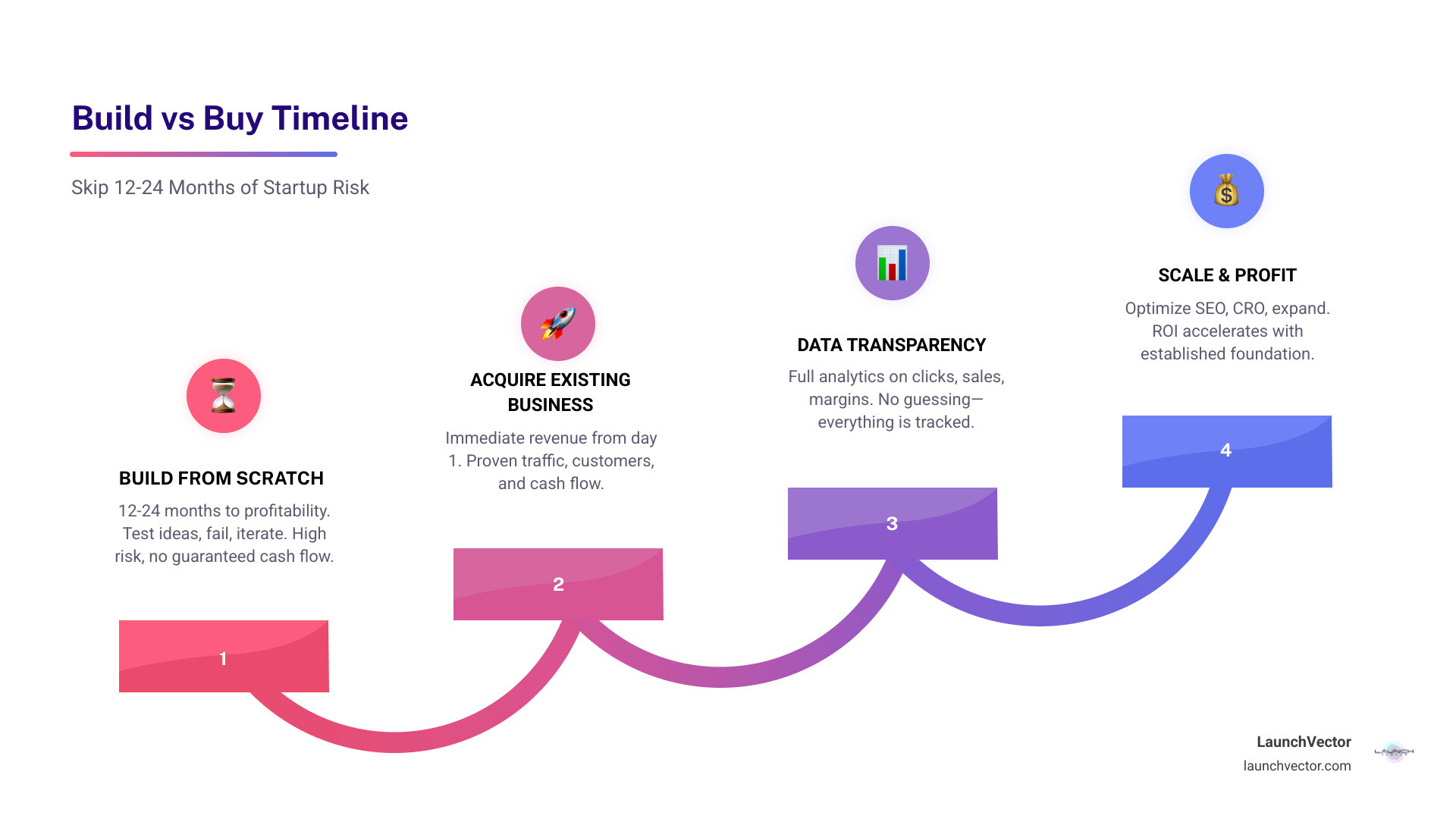
Building a profitable online business from scratch typically takes 12 to 24 months before you see meaningful revenue. That's 12 to 24 months of testing, failing, iterating, and burning through time and money — with no guarantee it works.
Buying changes that equation entirely.
When you acquire an established web-based business, you step into something that already works — proven traffic, existing customers, and real cash flow from day one. The digital marketplace in April 2026 is more active than ever, with platforms listing hundreds of thousands of online businesses annually and buyers deploying billions in verified acquisition capital.
The opportunity is real. But so are the risks if you don't know what you're doing.
I'm Zac Richman, founder of Launch Vector — an eCommerce acquisition and operations firm that has sourced, evaluated, and scaled a multi-million dollar portfolio of online businesses across dozens of verticals. My entire focus is helping entrepreneurs and investors buy web based business assets the right way: with rigorous due diligence, clean transitions, and a clear post-acquisition growth plan.
The Strategic Advantage of Digital Acquisitions
In the current landscape of April 2026, the shift toward "digital real estate" has accelerated. Why are so many entrepreneurs moving away from the "Main Street" dream toward the "URL" dream? It comes down to the fundamental differences in how these businesses operate and scale.
When you buy web based business assets, you aren't just buying a website; you're buying a data-backed machine. Unlike a local cafe where you have to guess how many people walk by each day, a web business provides an exhaustive trail of data. Every click, every customer journey, and every cent is tracked digitally.
| Feature | Traditional Brick-and-Mortar | Web-Based Business |
|---|---|---|
| Overhead | High (Rent, Utilities, Physical Staff) | Low (Hosting, Software, Remote Team) |
| Scalability | Limited by Geography/Physical Space | Global Reach; Infinite Scaling |
| Data Transparency | Often Opaque/Manual | High (Google Analytics, Stripe, CRM) |
| Flexibility | Location Dependent | Work from Anywhere |
| Inventory | High Physical Risk/Storage Costs | Often Dropshipped, Digital, or 3PL |
The core advantage is speed. By skipping the "ghost town" phase of a new website, you acquire proven traction. As we detail in The Digital Advantage: Investing in Ecommerce vs. Traditional Brick and Mortar Businesses, the ability to pivot and scale a digital asset far outweighs the heavy, slow-moving nature of physical storefronts.
Exploring the Landscape to Buy Web Based Business Assets
Before you pull the trigger, you need to know what’s on the menu. Not all digital assets are created equal. In 2026, the market is primarily divided into four main food groups:
- SaaS (Software as a Service): These are the "holy grail" for many because of recurring revenue. Subscription models are incredibly attractive because they provide predictable cash flow. SaaS businesses often command higher multiples—averaging 2.7x to 4.8x annual profit—because of this stability.
- Content Sites & Blogs: These earn money through display ads (like Mediavine or AdThrive) and affiliate marketing. They are often simpler to run but require a keen eye for SEO and traffic diversification. On average, these sell for around 1.95x annual profit.
- eCommerce & Shopify Brands: This involves selling physical goods. Whether it's a private label brand or a high-end dropshipping setup, these businesses are booming. If you're wondering Should You Buy an E-Commerce Brand, the answer depends on your appetite for supply chain management.
- Affiliate & Lead Gen Sites: These sites generate revenue by sending customers to other businesses. They have virtually zero customer support requirements, making them a favorite for "side hustlers."
Identifying high-growth niche opportunities—like AI-assisted tools or sustainable eCommerce—is where the real alpha is found.
How to Buy Web Based Business: A Proven 6-Step Roadmap
Acquiring a business is a process, not an event. If you rush the "wedding," you'll regret the "marriage." We follow a rigorous workflow to ensure every acquisition is sound.

Step 1: Define Your Search Criteria
Don't just look for "a profitable business." Narrow it down by industry, price point, and the amount of "owner hours" required. Are you looking for a passive investment or a full-time project?
Step 2: Source and Filter
Use legitimate marketplaces and professional brokerage networks. Seek out platforms that offer a wide range of assets and extensive networks of listings. For curated, high-end deals, focus on services specializing in profitable startups. If you're looking for local Wyoming-based digital opportunities, search for regional business listings and specialized digital asset brokers who understand the local landscape.
Step 3: NDA and Initial Inquiry
Once you find a listing that passes the "smell test," you’ll sign a Non-Disclosure Agreement (NDA). This grants you access to the "under the hood" data—the URL, the specific P&L, and the traffic sources.
Step 4: The Letter of Intent (LOI)
The LOI is your formal "handshake." It outlines your offer price and the terms of the deal. It usually includes an "exclusivity period" where the seller agrees not to talk to other buyers while you finish your homework.
Step 5: Deep-Dive Due Diligence
This is the most critical phase. You verify every claim the seller made. If they say they made $10,000 last month, you need to see the Stripe or PayPal records to prove it.
Step 6: Closing and Escrow
Never send money directly to a seller’s bank account. Use a secure escrow service. The funds are held by a neutral third party until the assets (domain, hosting, files, social accounts) are successfully transferred to you.
Valuation Benchmarks for 2026
How do you know if you're overpaying? In 2026, the "fair market value" for a successful web-based business typically sits between two to three times the company’s annual revenue, or more commonly, a multiple of the monthly net profit.
Several factors influence this multiple:
- Business Age: A site that is 3+ years old is worth significantly more than a 6-month-old "starter site" because it has survived Google algorithm updates and market shifts.
- Traffic Diversity: If 90% of traffic comes from one single keyword, the risk is high. Diversified traffic (organic, social, direct, and email) commands a premium.
- Revenue Concentration: Does one product account for all sales? If so, the multiple drops.
- SDE vs. EBITDA: For smaller businesses, we use Seller Discretionary Earnings (SDE), which is the profit left over after all operating expenses, including the owner's salary.
As we explain in our guide on Why Shopify Brands Are Appreciating Assets, brand equity and customer retention are becoming the primary drivers of high multiples in the current market.
Mastering Due Diligence and Financial Verification
Due diligence is where deals live or die. You are looking for "red flags" that indicate a business is propped up by smoke and mirrors.

The Traffic Audit
Always request "read-only" access to Google Analytics. Do not settle for screenshots, which can be easily faked.
- Organic Traffic: This is the gold standard. It shows the site has "authority" in the eyes of search engines.
- Direct Traffic: This indicates brand loyalty. People are typing the URL directly into their browser.
- Referral/Social: Be wary of massive spikes from social media that aren't sustainable or are driven by expensive paid ads.
Revenue and P&L Verification
You must ensure the profit is real. This involves Ensuring Financial Transparency: Verifying Profit and Loss Statements. Cross-reference the P&L with bank statements and tax returns. If the seller "forgot" to include certain expenses like software subscriptions or advertising costs, the "profit" is an illusion.
Churn and Retention
For SaaS or subscription eCommerce, churn is the silent killer. If the business is losing 10% of its customers every month, you are essentially pouring water into a leaky bucket.
Essential Questions to Ask Before You Buy Web Based Business
Before making an offer, get the seller on a call. Their answers (and how they give them) are often more revealing than the spreadsheets.
- Why are you selling? Common answers include "starting a new project" or "retirement," but look for signs of a looming market shift or a technical penalty.
- What does a typical week look like for you? If the owner is working 60 hours a week just to keep the lights on, it’s not a "passive" business.
- What are the biggest growth bottlenecks? This helps you identify where you can add value immediately after taking over.
- Are there any "skeletons in the closet"? Ask about past legal issues, trademark disputes, or Google penalties.
For a deeper dive into the "soft" assets of a company, see our guide on Navigating the Intangible: A Guide to Investing in Pre-Existing Ecommerce Brands.
Maximizing ROI and Transitioning Ownership
The first 90 days after you buy web based business assets are the most important. This is the "optimization window" where you can significantly increase the value of your new acquisition.
The Handover Process
A smooth transition requires a checklist:
- Domain Transfer: Move the domain to your own registrar (like NameCheap or GoDaddy).
- Asset Migration: Ensure all files, databases, and hosting accounts are moved.
- Supplier Introductions: If it's an eCommerce business, you need a warm intro to the manufacturers to ensure continuity.
- SOPs (Standard Operating Procedures): If the seller doesn't have these, your first job is to document every task so you can eventually delegate it.
Scaling Strategies
Once the "plumbing" is secure, focus on growth.
- Conversion Rate Optimization (CRO): Sometimes a simple change to the checkout page or the "Call to Action" buttons can increase revenue by 20% without spending an extra dime on traffic.
- SEO Scaling: Audit the existing content and look for "easy wins"—keywords where the site is ranking on page 2 and just needs a little push to get to page 1.
- Paid Media: If the business has high margins, look into scaling via Meta or Google Ads.
For those who want to mitigate risk, Fractional Ownership is an emerging trend in 2026, allowing investors to own a piece of multiple high-performing assets rather than putting all their eggs in one basket.
Frequently Asked Questions
What is the typical cost of a profitable web business?
Profitability comes at a price. Generally, you should expect to pay a multiple of the annual net profit. For most small to mid-sized web businesses, this ranges from 2x to 4x. For example, a business netting $5,000 per month ($60,000 per year) would typically sell for between $120,000 and $240,000. Factors like niche stability, brand strength, and owner involvement will push the price toward the higher or lower end of that spectrum.
Are there financing options for digital acquisitions?
Yes, though they differ from traditional real estate.
- SBA Loans: In the US, the Small Business Administration (SBA) has become more friendly toward digital assets, provided the business has a strong 2-3 year tax history.
- Seller Financing: This is common. You pay a portion upfront (e.g., 70%) and the remaining 30% is paid out over 12-24 months from the business's profits. This aligns the seller's interests with your success.
- Private Equity & Fractional Ownership: Many investors are now pooling capital to buy larger, more stable assets. You can learn more about how this works at Fractional Ownership: Reducing Risk, Empowering Investors.
How do I avoid scams and fraudulent listings?
The internet has its fair share of "get rich quick" schemes. Watch out for:
- Unrealistic Claims: "Make $30,000 a day with 5 minutes of work." If it sounds too good to be true, it is.
- High-Pressure Sales: "You have 24 hours to act or the deal is gone." Legitimate M&A takes time.
- Fake Traffic: Sites that use "bot" traffic to inflate their numbers. Always verify via Google Analytics and look for "engagement" metrics like time on site and bounce rate.
- Creative Bookkeeping: Ensure all expenses (including the owner's time) are accounted for.
If you ever feel unsure, you can contact the Bureau of Consumer Protection or your local Postmaster if you suspect mail or wire fraud.
Conclusion
The decision to buy web based business assets is one of the most effective ways to build wealth in the digital age. It allows you to skip the grueling startup phase and move straight into the role of an operator and strategist.
At LaunchVector, we believe you shouldn't have to do this alone. We specialize in curating and streamlining the acquisition of existing businesses. We don't just find the deal; we handle the expert evaluations, ensure a seamless transition, and provide a comprehensive 90-day optimization roadmap to maximize your ROI.
Whether you are looking for a side hustle or a flagship digital brand, we help you navigate the complexities of the market with confidence. We are so committed to the success of our acquisitions that we often partner with our clients to ensure long-term growth. You can learn more about our unique model here: Why Launch Vector Offers 50% Equity: Unlocking Opportunities for Potential Clients.
Ready to stop building and start owning? Start your acquisition journey with LaunchVector today.
Resources for Wyoming Entrepreneurs: