
Why Smart Entrepreneurs Buy Web Based Business Assets Instead of Building From Scratch If you want...
What Is a Small Business Merger — and Is It Right for You?
A small business merger is one of the fastest ways to grow a company, enter new markets, or acquire talent without building everything from scratch. Here's a quick breakdown of what you need to know:
- Merger: Two businesses combine to form a single new legal entity
- Acquisition: One business purchases and absorbs another, without creating a new entity
- True mergers are rare — it's uncommon for two equal companies to mutually benefit from fully combining
- Most deals are acquisitions, structured as either an asset purchase or a stock purchase
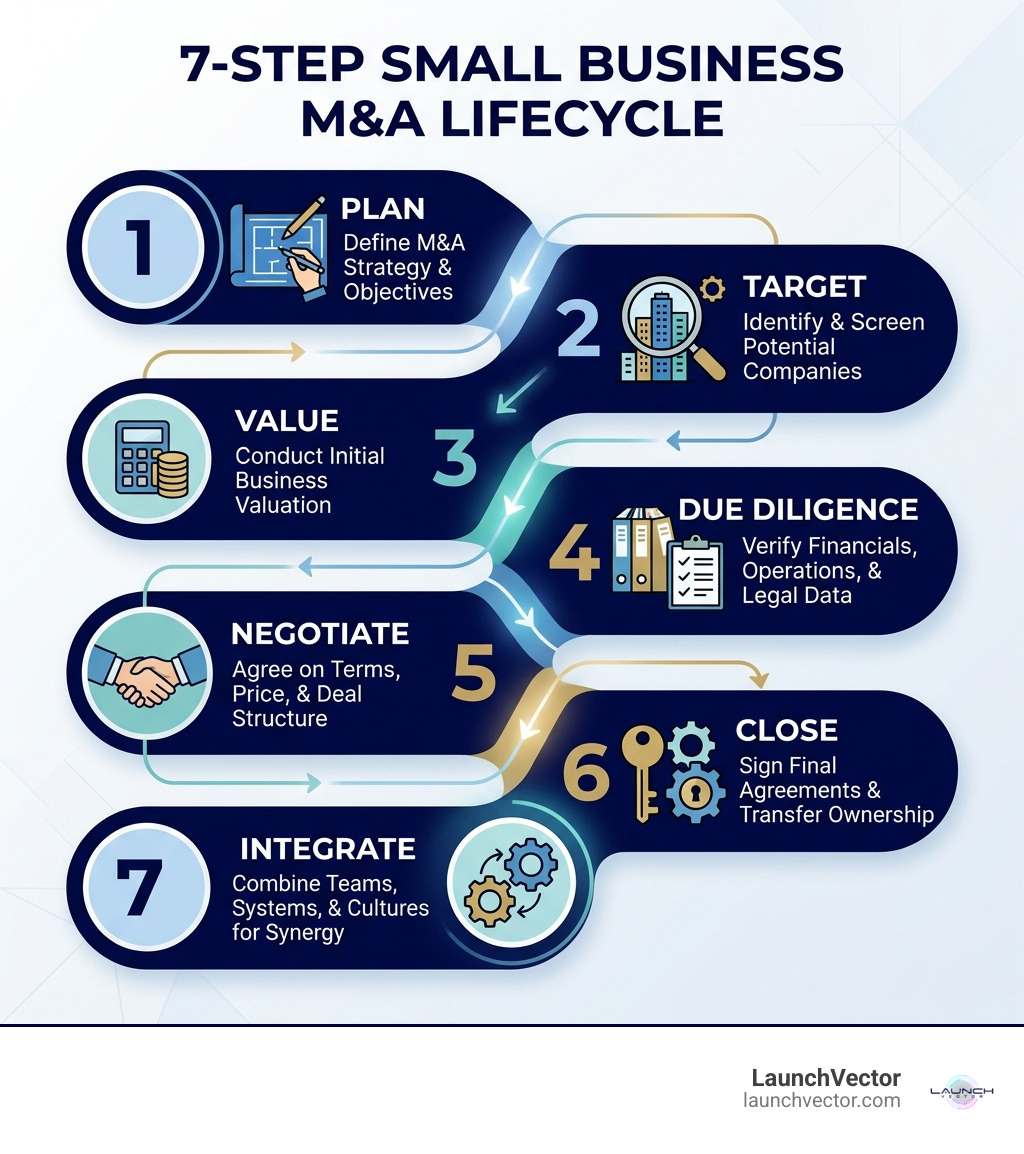
- The typical process takes 6–9 months, covering planning, valuation, due diligence, negotiation, and integration
- Key players you need: a business attorney, CPA, valuation expert, and financial advisor
Small businesses are increasingly using M&A as a strategic growth tool — not just large corporations. Whether you want to expand your customer base, eliminate a competitor, or buy into a proven operation, M&A can get you there faster than organic growth alone.
But speed without preparation is dangerous. Deals fall apart — or worse, close and then fail — because owners skip steps, underestimate integration, or let emotions drive decisions.
I'm Zac Richman, founder of Launch Vector, an eCommerce acquisition and operations firm with hands-on experience sourcing, evaluating, and scaling small business merger and acquisition deals across multiple verticals. In this guide, I'll walk you through exactly how the process works — and how to avoid the mistakes that sink most deals.
Merger vs. Acquisition: Understanding the Small Business Merger
In small business, people often use the terms "merger" and "acquisition" interchangeably, but they are legally and operationally distinct. As we navigate the landscape of April 2026, understanding these nuances is critical for any owner in Buffalo, WY, looking to scale.
A small business merger occurs when two companies—usually of similar size—decide to pool their resources and move forward as a single new legal entity. Both original companies cease to exist in their previous forms, and a new one is born. However, research shows that "true" mergers are actually quite rare. It is difficult for two CEOs to agree on who leads, and even harder for two equal companies to find a perfectly mutual benefit.
An acquisition is much more common. This is where one company (the buyer) purchases another (the target). The target company is absorbed into the buyer’s existing structure or kept as a subsidiary. In many cases, the acquired company eventually loses its independent identity.
Choosing Your Structure
When you decide to move forward, you have to choose how to legally "package" the deal. This has massive implications for your taxes and your liability.
| Feature | Asset Purchase | Stock Purchase | Merger |
|---|---|---|---|
| What is bought? | Specific items (equipment, IP, lists) | The entire legal entity (shares) | Two companies combine |
| Liabilities | Generally stay with the seller | Buyer inherits all past liabilities | New entity inherits everything |
| Tax Impact | Buyer can "step up" basis for depreciation | Usually more favorable for the seller | Can be complex; often tax-deferred |
| Commonality | Very common for small businesses | Common for larger, established corps | Rare for businesses of equal size |
According to the U.S. Small Business Administration, the legal transfer of ownership requires careful state registration. If you are operating in Wyoming, you'll need to follow specific filing requirements to ensure the new or surviving entity is recognized by the Secretary of State. This includes updating your business licenses, tax IDs (EIN), and bank accounts.
Strategic Preparation and Assembling Your Deal Team
We’ve seen many owners jump into a small business merger because they like the idea of being bigger, but they haven't defined the why. Before you ever sign an NDA, you need a clear strategic goal. Are you looking for vertical integration (buying a supplier), market expansion (moving into a new zip code), or talent acquisition (hiring an entire team at once)?
At LaunchVector, we often discuss how Why Launch Vector Offers 50% Equity: Unlocking Opportunities for Potential Clients can be a powerful tool for aligning interests in a deal. Strategic preparation means knowing exactly what "success" looks like 12 months after the papers are signed.
Your Professional Advisory Team
M&A is not a solo sport. Even the most seasoned entrepreneur needs a specialized team to flag risks that are invisible to the naked eye.
- Business Attorney: Your first hire. They draft the documents and ensure you aren't inheriting a lawsuit from 2022.
- CPA / Tax Expert: They analyze the "quality of earnings" and help you structure the deal to avoid a massive tax bill.
- Valuation Expert: To ensure you aren't overpaying based on "potential" rather than performance.
- Financial Advisor: To help manage the liquidity and capital structure of the new, larger entity.

One of the most critical early steps is the Nondisclosure Agreement (NDA). In a small community like Buffalo, word travels fast. An NDA protects your trade secrets and ensures that the "dating" phase of the merger remains confidential, protecting both parties' reputations.
The Roadmap to a Successful Small Business Merger
If you’re looking for a quick win, M&A might test your patience. The average small business sale takes six to nine months. It’s a marathon, not a sprint.
The process usually kicks off with a Letter of Intent (LOI). Think of this as a "written handshake." It’s generally non-binding, but it outlines the proposed price, the structure of the deal, and the timeline for due diligence. It shows the seller you’re serious and gives you a period of exclusivity where they can't shop the deal to other buyers.
As noted in the field guide for small business owners, the emotional side of these deals is often overlooked. For a seller, their business is their "baby." For a buyer, it’s a massive financial risk. Acknowledging these feelings and maintaining transparent communication with stakeholders—including employees and key customers—can prevent the deal from collapsing at the eleventh hour.
Valuation and Financing Your Small Business Merger
How much is the business actually worth? This is where many small business merger discussions hit a brick wall. Sellers often value their business based on future potential or "sweat equity," while buyers value it based on historical, provable cash flow.
Most small businesses are valued using a multiple of EBITDA (Earnings Before Interest, Taxes, Depreciation, and Amortization) or SDE (Seller's Discretionary Earnings). For example, a healthy service business might sell for 2x to 4x its annual profit. If you are looking at digital assets, we cover the specifics of this in our guide on Should You Buy an E-Commerce Brand.
Financing Options
You don't always need a mountain of cash to close a deal. In fact, most successful M&A transactions use a combination of sources:
- SBA 7(a) Loans: The gold standard for small business acquisitions. The SBA Buffalo District Office provides resources for Wyoming owners to access these government-backed loans, which often feature lower down payments and longer terms.
- Seller Financing: This is where the seller agrees to be paid a portion of the purchase price over time (usually 2-5 years). It’s a huge vote of confidence; if the seller is willing to tie their future income to the business's success, they likely aren't hiding any skeletons.
- Equity Partners: Bringing in investors to cover the down payment in exchange for a piece of the pie.
Due Diligence for a Small Business Merger
Due diligence is the "investigative" phase. This is where you verify that everything the seller told you is true. You should never take a profit and loss statement at face value without seeing the underlying data.
We advocate for extreme financial transparency and verifying P&L statements, especially when dealing with Shopify or e-commerce brands where "vanity metrics" can be misleading.
Your Due Diligence Checklist Should Include:
- Financials: At least 3 years of tax returns and audited financial statements.
- Legal: A deep dive into the Wyoming merger process and any existing contracts or leases.
- Intellectual Property (IP): Ensuring trademarks, domain names, and proprietary software are actually owned by the seller.
- Human Resources: Reviewing employee contracts, benefit plans, and the "key person" risk (what happens if the owner leaves?).
- Customer Concentration: If 50% of the revenue comes from one client, that’s a red flag.
Post-Acquisition Integration and Avoiding Common Pitfalls
The deal is signed. The champagne has been popped. Now the real work begins. Statistically, more M&A deals fail in the integration phase than in the negotiation phase.
Integration is about more than just merging bank accounts; it's about cultural alignment. If one company has a "work from home" culture and the other is "in-office 80 hours a week," you’re going to have a retention crisis on your hands. We recommend a 90-day roadmap to stabilize the ship. This includes setting clear KPIs and maintaining "relentless communication" with the team.
When investing in pre-existing brands, the intangible assets—like brand reputation and customer loyalty—are the most fragile. If you change everything overnight, you’ll scare off the very customers you just paid to acquire.

The Four Cs of Integration
To keep your team focused, use the "Four Cs" framework:
- Cull: Identify redundant systems or roles early to reduce waste.
- Care: Support the employees who are staying; they are likely anxious about their jobs.
- Communicate: Explain the "why" behind every change.
- Compensate: Use retention bonuses or performance incentives to keep key talent from jumping ship.
We also explore fractional ownership as a way to reduce risk during these transitions, allowing you to bring in expert management without the full overhead of a C-suite executive.
Frequently Asked Questions about Small Business M&A
How long does the typical small business M&A process take?
Generally, you should expect a timeline of 6 to 9 months.
- Months 1-2: Strategic planning and finding a target.
- Month 3: Negotiating the LOI.
- Months 4-6: Due diligence and securing financing (SBA loans can take 60-90 days alone).
- Months 7-9: Closing and starting the integration.
What are the most common pitfalls in small business mergers?
The biggest mistake is rushing due diligence. Owners get "deal fever" and ignore red flags because they want to close. Other common pitfalls include overestimating "synergies" (cost savings that never actually happen) and failing to account for the cultural clash between the two teams.
How is a small business properly valued for a deal?
A proper valuation looks at historical earnings (the last 3 years), the value of hard assets (inventory, equipment), and market position. Most small business deals use a multiple of SDE or EBITDA. However, "intangibles" like a proprietary database or a highly ranked website also play a significant role.
Conclusion
A small business merger or acquisition is a transformative journey. It’s the difference between climbing a mountain one step at a time and taking a helicopter to the summit. But as any pilot will tell you, the higher you go, the more important your equipment and your team become.
At LaunchVector, we specialize in making this process as hassle-free as possible. We curate and streamline the acquisition of existing businesses, providing the expert evaluations you need to ensure the numbers are real. Once the deal is done, we don't just walk away; we provide a 90-day optimization roadmap—handling everything from tech installs and ad optimization to sales scaling—to ensure your new acquisition hits the ground running.
Ready to stop building from scratch and start buying your way to the top? More info about our acquisition process is just a click away. Let's build something big together.