
Why Smart Entrepreneurs Buy Web Based Business Assets Instead of Building From Scratch If you want...
The Smartest Way to Enter Ecommerce in 2026 Is to Buy, Not Build

Ecommerce businesses for sale are everywhere right now — and for ambitious entrepreneurs, that's a massive opportunity.
Here's a quick snapshot of the types of businesses available and where to find them:
| Platform Type | Business Types Available | Price Range |
|---|---|---|
| Public Marketplaces | Shopify, FBA, Dropship, eBay | $0 – $250K+ |
| Curated Brokerages | Amazon FBA, DTC Brands, Subscription | $50K – $5M+ |
| Private M&A Firms | Shopify, DTC, Wholesale | Varies |
| Business Directories | Amazon, Shopify, Turnkey Stores | $50K – $2M+ |
Top ecommerce categories available in 2026:
- Health & Beauty
- Home & Garden
- Electronics
- Apparel & Fashion
- Automotive
- Food & Drink
Global ecommerce is on track to exceed $6.8 trillion in sales. Yet most entrepreneurs still grind through the startup phase — building from zero, burning cash, and hoping the market responds. There's a faster path.
Buying an established ecommerce business means you skip the painful early months. You get an existing brand, proven suppliers, a real customer base, and — most importantly — cash flow from day one.
The math is straightforward. Starting a store costs time and money with no guaranteed return. Buying one means you're acquiring something that already works.
I'm Zac Richman, founder of Launch Vector, an ecommerce acquisition and operations firm that has sourced, acquired, and scaled a multi-million dollar portfolio of ecommerce businesses for sale across multiple verticals. In this guide, I'll walk you through exactly how to find, evaluate, and acquire the right ecommerce business — without wasting time or leaving money on the table.
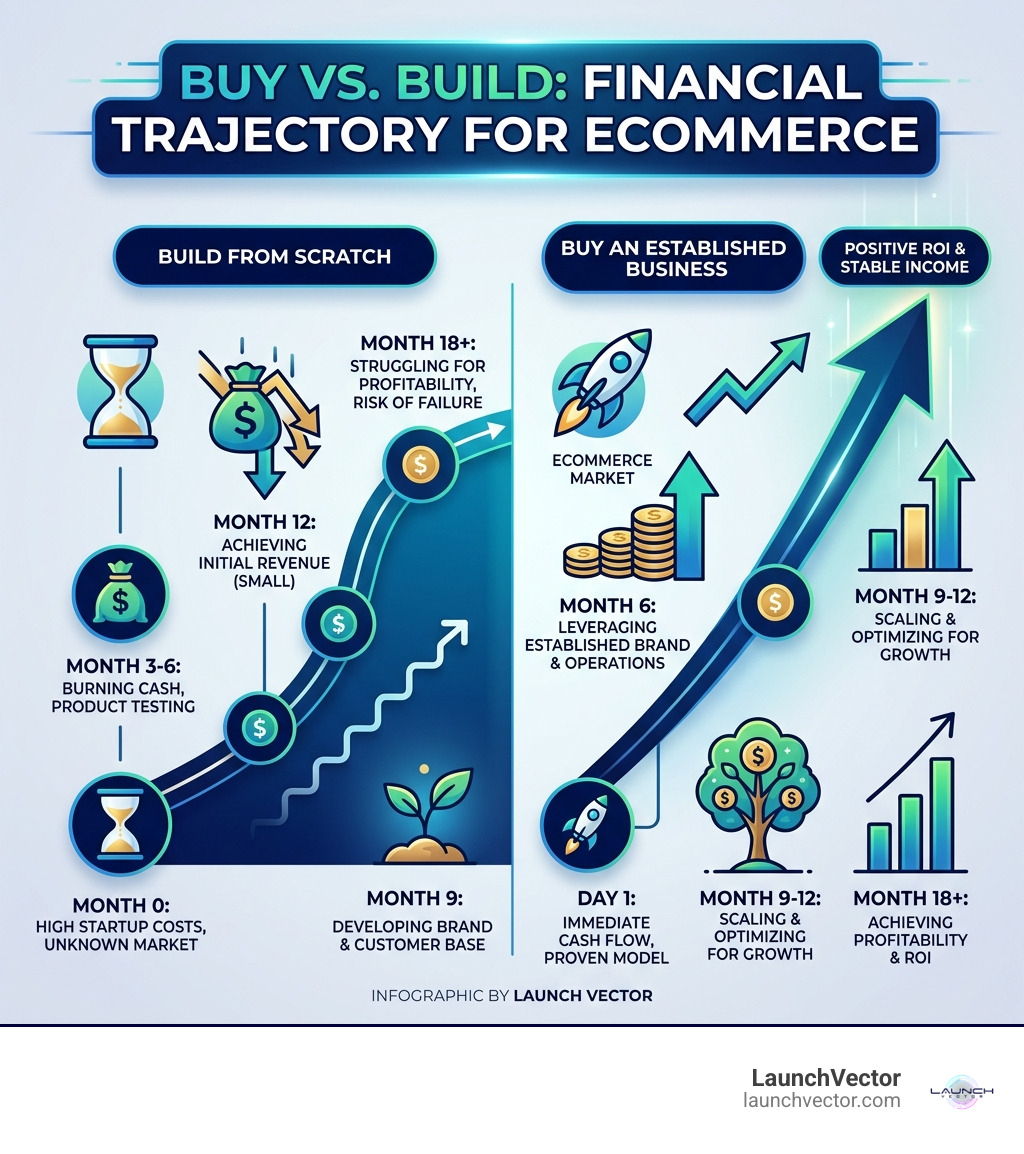
Why Buying Established Ecommerce Businesses for Sale Beats Starting from Scratch
Starting a business from scratch is often romanticized, but the reality involves a lot of "expensive learning." When we look at the landscape in April 2026, the data shows that acquiring an existing asset is the fastest way to achieve a return on investment. According to the U.S. Small Business Administration, buyers who perform disciplined due diligence and acquire proven businesses often reduce many of the early-stage risks that come with launching from zero.

When you look for ecommerce businesses for sale, you aren't just buying a website; you are buying a shortcut. One of the biggest hurdles for any new store is "product-market fit." In a startup, you spend months (and thousands of dollars) testing ads to see if anyone actually wants your product. With an acquisition, that proof is already in the bank.
Immediate Cashflow and Stability
Unlike a startup that might not see a profit for 18 months, an established ecommerce brand provides immediate cash flow. This allows you to reinvest in growth or pay down acquisition financing right away. Furthermore, you inherit existing supplier relationships. In 2026, supply chain stability is a massive asset. Having a vetted manufacturer who already knows the brand's quality standards saves you from the "sample-testing" nightmare.
Unlocking the Value: Why Shopify Brands Are Appreciating Assets is a concept we talk about often at LaunchVector. Brands on platforms like Shopify are no longer just digital storefronts; they are tangible assets that appreciate as you optimize their conversion rates and customer lifetime value.
Brand Equity and the Intangibles
There is a "trust gap" with new websites. Customers are hesitant to buy from a brand with zero reviews and a three-month-old domain. By Navigating the Intangible: A Guide to Investing in Pre-Existing Ecommerce Brands, you step into a role where the trust is already built. You get the SEO keywords, the social media following, and the trademarked brand name that would take years to build from zero.
The Advantage of Age and History
In ecommerce businesses for sale, age is a premium metric. While "starter sites" (0-6 months old) are cheap and plentiful, they carry the same risks as starting from scratch.
We prefer looking at brands with at least 2 to 5 years of history. Why? Because they have weathered market shifts. A brand that survived the post-pandemic correction and the inflation spikes of the mid-2020s is a "recession-proof" candidate.
Case Study: The Power of Legacy Consider a leading EU football gear retailer with a 19-year brand history. With over $1.58M in revenue and 100,000+ orders, this business isn't just a store; it is a legacy. It has 10,400 SEO keywords driving organic traffic. If you tried to build that today, your customer acquisition cost (CAC) would be astronomical. Buying that history allows you to focus on optimization rather than survival. Should You Buy an E-Commerce Brand often comes down to this: do you want to be an inventor, or do you want to be an owner?
Navigating the Landscape of Ecommerce Businesses for Sale
The market for digital assets is more diverse than ever. Depending on your goals—whether you want a passive side hustle or a full-time empire—there is a specific model that fits your needs.
Understanding the Different Business Models
- Amazon FBA (Fulfillment by Amazon): These are popular because Amazon handles the heavy lifting of shipping and customer service. You focus on inventory and PPC.
- Shopify / Direct-to-Consumer (DTC): These offer the highest brand control. You own the customer data, which is vital for long-term value.
- Dropshipping: Low overhead because you don't hold inventory, but margins are often tighter and you are at the mercy of your suppliers' shipping speeds.
- Inventory Holding: The traditional model. You buy in bulk, store the goods, and ship them. This offers the best margins (often 20%+) but requires more operational oversight.
Example: High-Growth Scaling We recently analyzed a highly profitable health and beauty eCommerce business with $4M revenue and 15% profit margin. This business was established in 2025 and already shows massive potential. In the health and beauty niche, repeat customers are the "holy grail." Acquiring a brand like this allows you to leverage an existing database of thousands of customers who are already in a subscription or reorder cycle.
Popular Categories for Ecommerce Businesses for Sale
Not all niches are created equal. In 2026, we are seeing specific "heavy hitter" categories that dominate the marketplaces.
| Vertical | Typical Net Margin | 2026 Growth Outlook |
|---|---|---|
| Health & Beauty | 15% - 30% | High (Subscription potential) |
| Home & Garden | 12% - 22% | Steady (Evergreen) |
| Electronics | 8% - 15% | Moderate (High AOV) |
| Automotive | 15% - 25% | High (Niche enthusiast) |
| Pet Care | 15% - 20% | Recession-Proof |
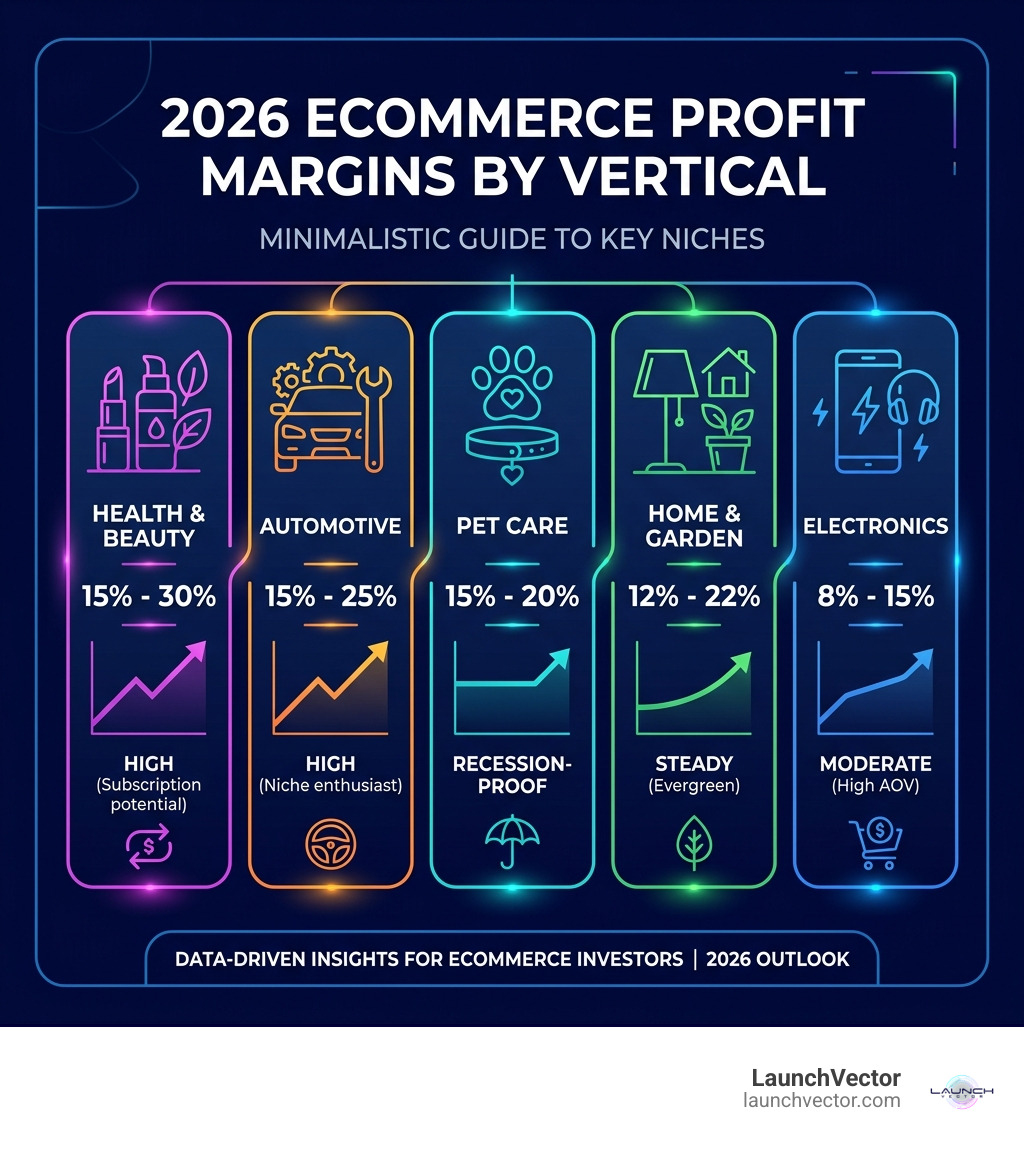
Filtering Your Search for Ecommerce Businesses for Sale
When browsing marketplaces, the sheer volume of listings can be overwhelming. We recommend using specific filters to find the "sweet spot":
- Price Ranges: You can find starter sites for $0-$999, but for a viable income, look in the $50K to $250K+ range.
- Monthly Profit: Don't just look at revenue. A business making $1M in revenue but only $10K in profit is a "vanity" business. Look for healthy SDE (Seller’s Discretionary Earnings).
- Age Requirements: Filter for businesses at least 12-24 months old to ensure the "honeymoon phase" of a new launch isn't masking a dying trend.
- Geographic Targeting: While ecommerce is global, many buyers prefer businesses based in the US (like those in Buffalo, WY) for easier legal transitions and tax planning. Looking for Wyoming-based ecommerce businesses is a great way to start if you want to keep things local.
Critical Metrics for Evaluating Potential Acquisitions
Evaluating ecommerce businesses for sale requires a cold, hard look at the data. At LaunchVector, we tell our clients that the "story" the seller tells is interesting, but the P&L (Profit and Loss statement) is the truth.
Seller’s Discretionary Earnings (SDE)
This is the most important number you will see. SDE is the total financial benefit a single owner-operator gets from the business. It includes the net profit plus any "add-backs" like the owner's salary, one-time legal fees, or non-essential travel.
Most ecommerce businesses for sale are valued at a multiple of SDE. In 2026, typical multiples range from 2.5x to 4.5x annual SDE. If a business makes $100,000 in SDE, you can expect to pay between $250,000 and $450,000 for it.
Reading & Understanding Your P&L is a skill every buyer must master. You need to look for consistency. Are there weird spikes in expenses? Is the marketing spend sustainable? Ensuring Financial Transparency: Verifying Profit and Loss Statements When Acquiring a Pre-Existing Shopify Brand is the only way to avoid buying a "lemon."
Operational and Traffic Due Diligence
Beyond the money, you must audit the "engine" of the business:
- Unique Visitors: Is the traffic growing? Is it coming from organic SEO or is it 100% dependent on expensive Facebook Ads?
- Conversion Rate: A 1% vs. 3% conversion rate is the difference between a failing business and a goldmine.
- Customer Acquisition Cost (CAC): If it costs $20 to acquire a customer but the average order value is $25, the business is on thin ice.
- Social Media Following: Are the followers real? Check the engagement rates.
For those who want to mitigate risk, Fractional Ownership: Reducing Risk, Empowering Investors is becoming a popular trend in 2026. This allows you to own a piece of a "Heavy Hitter" business without the full operational burden.
Frequently Asked Questions about Ecommerce Acquisitions
How much do ecommerce businesses typically sell for in 2026?
The market has matured significantly. While you can find small dropshipping sites for $5,000, established brands with proprietary products usually trade at 3x to 4x their annual SDE. High-growth SaaS-integrated ecommerce or subscription-based models can sometimes fetch 5x or higher. If you are looking at revenue multiples, 1x to 2x annual revenue is standard for healthy DTC brands.
What is the difference between FBA and Dropshipping acquisitions?
Fulfillment by Amazon (FBA) is essentially buying a spot in Amazon's ecosystem. It’s highly scalable but you are at the mercy of Amazon’s fees and algorithm. Dropshipping is "asset-light"—you don't own the inventory—but you have less control over the customer experience and shipping times. In 2026, we see higher valuations for "Inventory Holding" or "Hybrid" models because they represent a more defensible brand.
How do I verify the financial health of a listing?
Never take a screenshot at face value. You should request:
- View-only access to the Shopify/Amazon backend.
- Merchant processor exports (Stripe, PayPal) to match the sales numbers.
- Tax returns for the last two years.
- Supplier invoices to verify the cost of goods sold (COGS). If a seller refuses to provide these, walk away. There are plenty of other ecommerce businesses for sale with transparent owners.
Conclusion
The window of opportunity for acquiring high-quality ecommerce businesses for sale is wide open in 2026, but it requires a disciplined approach. Whether you are looking for a turnkey women's boutique with $980K peak revenue or an established fashion eCommerce business with $148K revenue and 28% profit margin ready for Q4 scaling, the key is due diligence.
At LaunchVector, we don't just help you find a business; we help you own it. From our expert evaluations to our 90-day post-acquisition optimization roadmap, we ensure your transition is seamless. We handle the "tech stack" headaches, the ad account setups, and the sales optimization so you can focus on being the CEO.
Don't spend another year "building" a dream that might never launch. Start buying the reality that is already producing results.
Start your acquisition journey with our proven process and let's find your next "Heavy Hitter" together.